Lee el artículo completo en Español AQUI
IN ENGLISH (See Below)
CENTRO UNIVERSITARIO DE TONALA – July 14, 2026
LIFE AND WORK
_________________________________
VICTORIA DELGADILLO
Artist of Chicano Memory and Community Art by Camila Guerrero Peña
Victoria Delgadillo is an artist whose work explores Chicano history, collective memory, and community-based art.
Victoria Delgadillo is a renowned Chicana artist from Los Angeles whose work bridges artistic creation with memory, community engagement, and social justice. Her significance in the contemporary context rests on her role as an agent of change within the history of art from a gender perspective; she challenges hegemonic narratives and legitimizes the presence of women in spheres from which they were systematically excluded. Rather than adhering to a single style, she is a hybrid-media artist.
A graduate of the University of California, San Diego (UCSD)—where she studied film theory and video production—she was part of the first group of one hundred Chicana students admitted to the institution during the 1970s. That experience marked the beginning of a multidisciplinary career spanning painting, screen printing, photography, textile art, installation, and performance art, but above all, the creation of short films and experimental movies. Her work is a constant collage of influences: the aesthetic of French New Wave cinema coexists with the iconography of Mexican popular culture.
Her career unfolded during a period when women artists, especially Chicana and Latina women, were seeking greater representation within the cultural and academic spaces of the United States. Victoria has noted that her time at university strengthened her awareness of the inequalities faced by Mexican-American women and communities, an experience that influenced her decision to create art linked to participatory culture.
Her decision to integrate community-based practice into her artistic work was not accidental, but rather a strategy to dismantle the hierarchy between artist and spectator. Far from viewing art as an exclusively aesthetic or commercial object, Delgadillo has developed a practice centered on collective work. She has collaborated with groups such as Mexican Spitfires and participated in projects like Maestras Atelier XL, coordinated by Diane Gamboa. She also played an active role in defending Self Help Graphics & Art, a cultural institution in East Los Angeles.
“I moved to Los Angeles with the desire to participate in founding contemporary Chicano culture through the visual arts. I sought an open creative space where social and spiritual healing could take place… Upon reflection, I realized that I was part of creating value, organizing principles, developing methods, and providing the networks that helped build successful artistic expressions that have crossed all borders and minds with justice.” – Victoria Delgadillo
In her work, she reinterprets everyday objects from Mexican popular culture—such as aprons, textiles, and market bags—to reflect on identity, migration, and the effects of global consumption. Her artistic career addresses critical issues such as gender-based violence and the humanitarian crisis at the Mexico-United States border. Notable among her signature initiatives is the exhibition *Women of Juárez: Rastros y crónicas* (2009)—hosted at the time by the National Museum of Mexican Art—as well as the coordination of community interventions and workshops held simultaneously on an international scale.
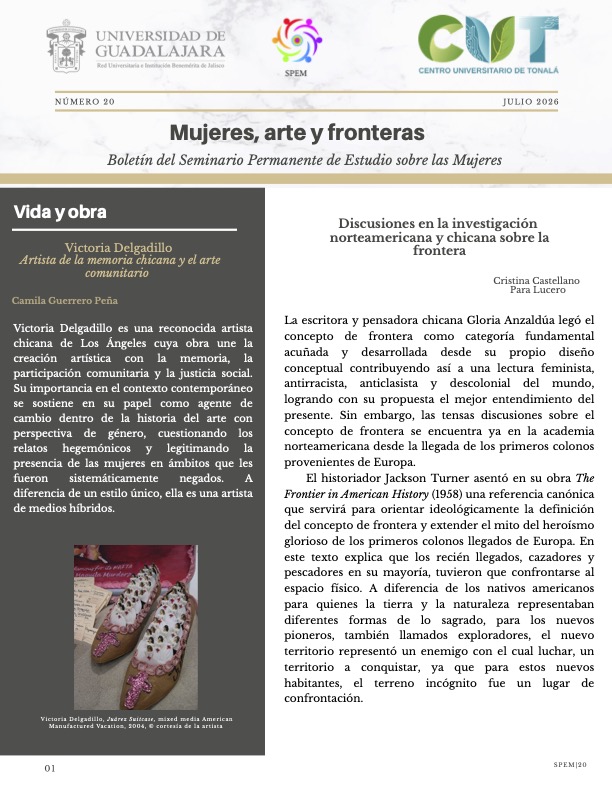
Under the mentorship of feminist pioneer Judy Chicago, the artist developed works such as *American Manufactured Vacation* and *Juárez Suitcase*, in which she examined the links between globalization, precarious labor, and systemic violence against women. The work of Victoria Delgadillo. is part of significant international collections, including LACMA, the National Museum of Mexican Art, and the Vincent Price Art Museum. Her artistic practice is distinguished by its ability to intertwine community art with Chicana feminism and cultural memory, transforming visual creation into a powerful vehicle for transformation. Through her projects, Delgadillo demonstrates how art can be, simultaneously, an exercise in profound introspection and a catalyst for dialogue and social engagement.
References
Albert, S. B., & García, C. M. (Eds.). (2015). The femicide of Ciudad
Juárez: Legal and cultural repercussions of impunity. International University of Andalusia. http://hdl.handle.net/10334/3658
Delgadillo, V. (n.d.). Victoria Delgadillo: Artist and Activist. Official artist platform. https://victoriadelgadillo.com/
Los Angeles, CA. López Ricoy, A. (2025). International Political Sociology, Multivocal Anti-Femicide: Aesthetic Frames and the Making of the Women of Ciudad Juarez as a Global Injustice Symbol. 19(3), olaf016. https://doi.org/10.1093/ips/olaf016
Maldonado, R. (2003). Contributors. Aztlán: A Journal of Chicano Studies, 28 (2), 269. University of California Press. University of California, Santa Barbara. (s.f.).
Torres Rodríguez, K. (November 27, 2018). Show chicanart through poetry and cinema. UdeG Gazette. University Center of Tonala