
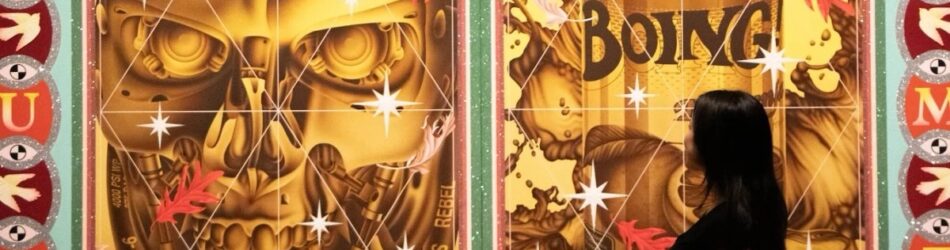
‘When Robots Rebel’ (2023), by Jaime Muñoz, included in the exhibition ‘AztLÁn, Tunnel of Time’. Photo: Federal Ministry of Culture
July 30, 2026 07:48 – by Daniel López Aguilar
Graffiti artist Chaz Bojórquez, photographer Graciela Iturbide, artist Beatriz Cortez, and singer, writer, and activist Alice Bag will participate in the first International Chicanx Art Encounter, which from today until August 1st will bring together artists, researchers, and specialists at the Palace of Fine Arts to reflect on the relevance, diversity, and new scope of this cultural phenomenon.
“The Chicano identity functions as a conceptual platform. This initiative arises as a critical extension of the exhibition AztLÁn, Tunnel of Time ,” Joshua Sánchez, chief curator of the Museum of the Palace of Fine Arts, told La Jornada .
In his view, the movement has ceased to be understood solely as a relationship between Mexico and the United States, becoming instead a space where Latin American aesthetics and narratives converge. “It is no longer just a binational relationship; contemporary migratory flows compel us to consider the phenomenon from a much broader perspective.”
The program will bring together curator Daniela Lieja; Rita González, head of the Department of Contemporary Art at the Los Angeles County Museum of Art; philosopher Sayak Valencia; and writer and activist Luis J. Rodríguez, among other figures. The panels will address topics such as community organizing, punk, graffiti, photography, film, and the transformations of the movement, with the aim of placing these voices in dialogue with Mexican interlocutors.
Although the project began to take shape three years ago, the political context ultimately gave it a different resonance. The curator noted that the Palace of Fine Arts Museum decided to open a space for reflection on Chicano communities and the tensions at the border.
“We never imagined the scale that hate speech aimed at criminalizing Mexicans living in the United States would reach. Faced with this scenario, the museum cannot be indifferent or turn a blind eye.”
This stance also reflects the historical mission of the Palace of Fine Arts Museum. He recalled that the institution was founded around the murals of Diego Rivera, José Clemente Orozco, and David Alfaro Siqueiros, conceived to engage with the conflicts of their time. “The museum’s mission is to generate conversations and questions that allow us to examine our present.”
The meeting also stems from a debt owed to Chicano communities, who for decades faced discrimination in both the United States and Mexico. That gap is beginning to narrow thanks to greater access to information and the recognition of the historical and familial ties that bind the two countries.
“Almost no family in Mexico could say they don’t have a relative in the United States, whether parents, siblings, nephews, or grandparents. That connects us in an emotional, economic, political, cultural, and culinary sense,” Joshua Sánchez pointed out. “We seek to value the contribution of the Mexican diaspora in the United States, beyond the economic sphere: also in the aesthetic, cultural, and artistic realm, which is incredibly powerful.”
He (Joshua Sánchez) also highlighted, as associate curator of AztLÁn, time tunnel , that the participating artists come from diverse backgrounds: from creators trained at universities such as Yale, the Universities of California in Los Angeles and San Diego and the California Institute of the Arts to self-taught authors who recover family and community knowledge.
Plurality
This plurality demonstrates how Chicano art has broadened its references and engages with other migratory imaginaries. The works blend languages, traditions, and cultural references to generate, in the curator’s words, “new concepts, words, and ways of understanding the world,” as well as linking Mesoamerican imaginaries with contemporary expressions.
Among the works, the installations of Guadalupe Rosales stand out, which seek to allow those who have historically remained outside of museum narratives to see themselves reflected in these spaces.
Regarding the audience’s response, Sánchez expressed his hope that they will discover a “vibrant” artistic production, “capable of escaping stereotypes. We want these kinds of projects to be mirrors where, collectively, we can recognize and value the beauty of who we are.”
The talks will take place from today until next Saturday, at 10 a.m., in the Manuel M. Ponce room of the Palace of Fine Arts (Juárez Avenue s/n, corner of Eje Central Lázaro Cárdenas, in the Centro neighborhood, Cuauhtémoc borough), with free admission.
In addition, Room 9 of the Cineteca Nacional México is showing a series of five programs of documentaries, short films, experimental films and historical materials made between 1908 and the present, dedicated to the experiences and imaginaries of Chicano and Mexican-American communities.