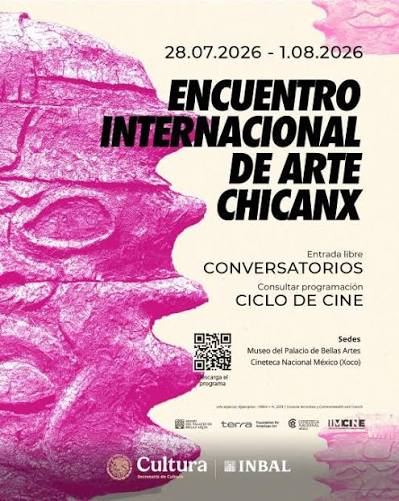
Running from July 30 to August 1, 2026 The Aztlán, Tunnel of Time exhibition, was a space for dialogue and film opened around the Chicanx (aka Chicano) art movement of Mexico and the United States. Featured were Alice Bag, Beatriz Cortez, Chaz Bojórquez, Daniela Lieja, Graciela Iturbide, Luis J. Rodríguez, Rita Gonzalez, and Sayak Valencia, among other figures linked to Chicanx art and culture.
The Ministry of Culture of the Government of Mexico and the National Institute of Fine Arts and Literature (INBAL), through the Museum of the Palace of Fine Arts, presented the International Chicanx Art Encounter, which took place within the framework of the exhibition Aztlán, Tunnel of Time. The program brought together artists, researchers, curators, filmmakers, and cultural agents to reflect on the multiple expressions of the Chicanx movement, recognizing its diversity, and exploring its relevance for understanding the cultural relations between Mexico and the United States.
The Secretary of Culture of the Government of Mexico, Claudia Curiel de Icaza, celebrated that the exhibition Aztlán, Tunnel of Time giving rise to an international meeting that brought together artists, researchers, creators and historians to discuss the relevance of the Chicanx movement. “That this dialogue is taking place at the Palace of Fine Arts confirms that our cultural spaces are also places to listen to different voices, recognize a shared history, and strengthen the bonds that art builds between communities. In times when dialogue is essential, culture continues to be a path to understanding, coexistence, and peace building,” Curiel de Icaza stated.
The National Film Archive of Mexico hosted film series screenings, offering new perspectives on the Chicanx artistic movement through dialogue, film, and critical reflection. Topics in the film series included, “Solidarity Communities: From Transtemporal Narratives to Transborder Territories” with artist Beatriz Cortez and curator Daniela Lieja, moderated by Joshua Sánchez, chief curator of the INBAL. The discussion will explore the relationship between artistic practices, curating, and research in contemporary Chicano and Latino. “Curating, Writing, and Political Imagination,” featuring Rita Gonzalez, head of Contemporary Art at the Los Angeles County Museum of Art (LACMA); Sayak Valencia, PhD in Philosophy; and Luis J. Rodríguez, writer and activist. Moderated by Minerva Reynosa, head of the Literature Department at INBAL (National Institute of This panel explored curating and writing as tools for making visible the experiences of Chicanx communities and questioning the violence that permeates border territories.
The conversation “So what! Writing, occupying, reclaiming!” took place featuring Chaz Bojórquez, a pioneer of Chicano graffiti, in conversation with the artist Said Dokins. Their topic was “Urban Writing as an Aesthetic and Political Practice.” They also spoke about graffiti as an artistic language of international reach.
The last conversation presentation was dedicated to the connections between music, photography, and the visual arts, title “Punk Chicanx: Music, Identity, and Resistance ” featuring singer, writer, and activist Alice Bag and radio host, journalist, music critic Raúl Vázquez (Rulo). Their themes were about music and performance as tools to challenge racism, sexism, and other forms of exclusion, as well as building spaces of community and cultural resistance.
Photographer Graciela Iturbide and Rubén Ortiz-Torres led a discussion on White Fence Gang , a photographic series Iturbide created in East Los Angeles during the 1980s. The conversation addressed the social, cultural, and documentary dimensions of this project, as well as its relevance to understanding photography as a medium of memory and community identity.
The Film series
In addition to “Community Resistance and Chicanx culture” at Punto Magnolia featuring “Califas” by Raul Baltazar & Victoria Delgadillo, some of the other film presentations and topics were:
As part of the Encuentro, the Cineteca Nacional México hosted a series of programs presented by Jesse Lerner, filmmaker, researcher, and curator of the exhibition Aztlán, Tunnel of Time, along with several guests. Through documentaries, short films, experimental cinema, and historical materials produced between 1908 and the present, the series will complemented the exhibition and offered a journey through diverse representations of the experiences and imaginaries of Chicanx and Mexican-American communities.
Topics were “To Hell with Hollywood ” a selection that confronted the stereotypes constructed by the US film industry about Mexican and Chicanx communities and the critical responses developed by filmmakers from that community, including documentaries, short films, and historical materials and live musical performance such as “The Greaser’s Gauntlet” (1908) by José María Serralde Ruiz. Another session was on Painting and Art presented by artist Diego Robles, exploring the links between film, muralism, performance and the visual arts, through works related to the legacy of David Alfaro Siqueiros in Los Angeles and the Asco collective of ELA. “The Past is a Foreign Country” was pivatol episodes in Chicanx history through films that recapture key moments in collective memory and challenge official narratives about that experience with writer and director Jim Mendiola. “Indigenous Experiments” a reflection on the Indigenous roots that predate the contemporary border and the cultural continuities between Mexico and the southwestern US with filmmaker Christina Ibarra and artist John Jota Leaños. “We Didn’t Cross the Border, the Border Crossed Us” dedicated to the border as a space of creation, memory, and resistance with visual artist and researcher Yadira Ávila.
This Chicanx International Art Encounter offered a space for the exchange of ideas and the building of new connections among artists, researchers, institutions, and diverse audiences. Rather than offering a single definition of the Chicanx movement, the encounter invited participants to recognize its plurality and its continued relevance as a space for reflection on migration, memory, identity, and the imaginary borders that separate us.
This event was made possible through the support of the Terra Foundation for American Art, through its Grants Program.